LiebherrRepair Miami

12 conditions, every one from the maker's own manual

Liebherr error codes, and what the maker will not decode.

Liebherr prints F1 to F5 on the display and publishes no meaning for any of them: its own manual asks only that you have the number available when you call. Pages that decode them cite nothing. So this archive is short and everything in it is real — five numbers described honestly as references, and seven behaviors the maker does document in detail, which is where the answers on this make actually live.

  • 5 numbers the maker prints
  • 7 documented indicators, not codes
  • 0 of them the maker decodes
  • from $95 diagnostic, credited to the repair

Search the archive

Type what the display is showing

Partial entries work, and letters matter — F1 and FF are different things. If your appliance has no display at all, which on this make is the commoner case, describe what it is doing and start from the symptom pages instead.

Nothing here is invented. Every entry names the manual or the FAQ page it came from, and where this maker publishes no code for a machine, this archive says so rather than filling the gap.

Why this archive is short

Two hundred pages of codes would mean somebody invented them.

Two hundred and eighty-eight product pages on this maker’s own US site were read for the manuals they link to. Sixty-nine distinct manuals came back. Three of them contain a table of codes. Not three per appliance — three in total.

That is not a documentation failure, it is what the equipment is. A gas range diagnoses by flame: how it sits on the port, what color the tip is, whether it holds when you let the knob go. There is nothing for a display to say. So this site puts its weight on the symptom pages, which describe what an appliance is doing, and keeps this archive to what the maker actually prints. A sister site on this fleet was once caught publishing about thirty-eight “codes” that were somebody’s guesses dressed as a table, and that is the mistake this page exists to make impossible.

Start from what it is doing instead
An open printed manual lying on a dark stone worktop under warm light, the page deliberately out of focus so no words can be read, a pencil beside it.

Before you clear it

Four things worth doing while the display is still showing something

On a machine that only reports occasionally, what is on the panel right now is the whole of the evidence. None of this takes more than a minute.

Photograph it

  • The letter matters as much as the number — F1 and FF are different things
  • A photograph beats writing it down, and beats reading it out on the phone

Note what the machine was doing

  • Which program, how far into it, and whether it had run normally before
  • A code with a story attached is worth several times a code on its own

See whether it survives a power cycle

  • Two full minutes at the breaker, not two seconds at the control
  • Whether it comes back, and how quickly, separates a confused control from a real failure

Check the free causes it names

  • Several of these codes point at a tap, a hose filter or a drain rather than at the appliance
  • The page for each one says which, and what to look at first

By appliance

Which machine is showing it

Five numbers and seven signals. Type what your display is showing, or describe what it is doing — on this make the second is more likely to find you an answer than the first.

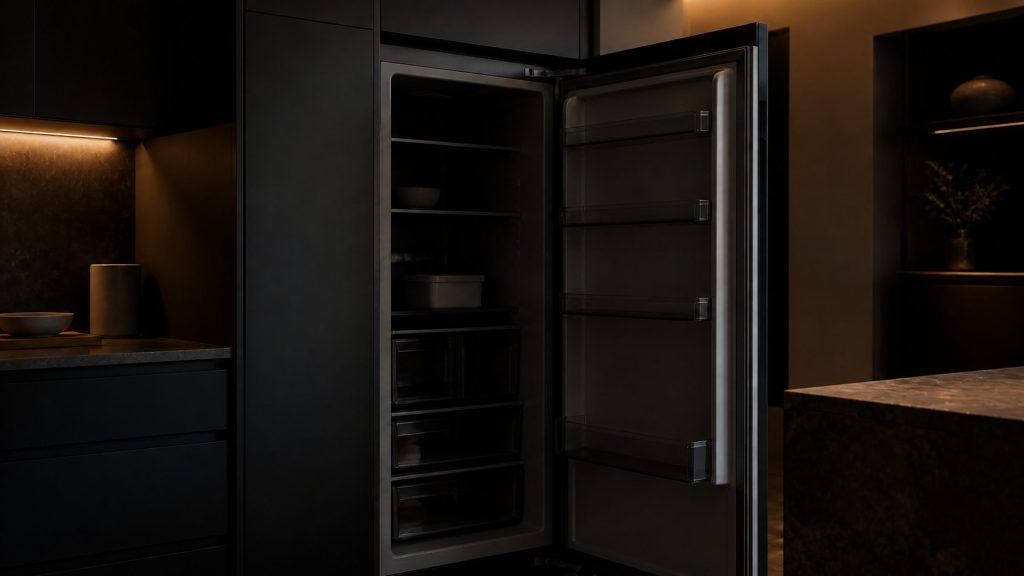
  • A tall fully integrated refrigerator column standing open in a near-black kitchen, its own cabinet front on the door, cold interior light on glass shelves holding a few plain containers and vegetables, dark stone worktop to the left and warm amber under-cabinet light beyond.
    Bottom-freezer · Side-by-Side · French-door · fully integrated

    Refrigerators

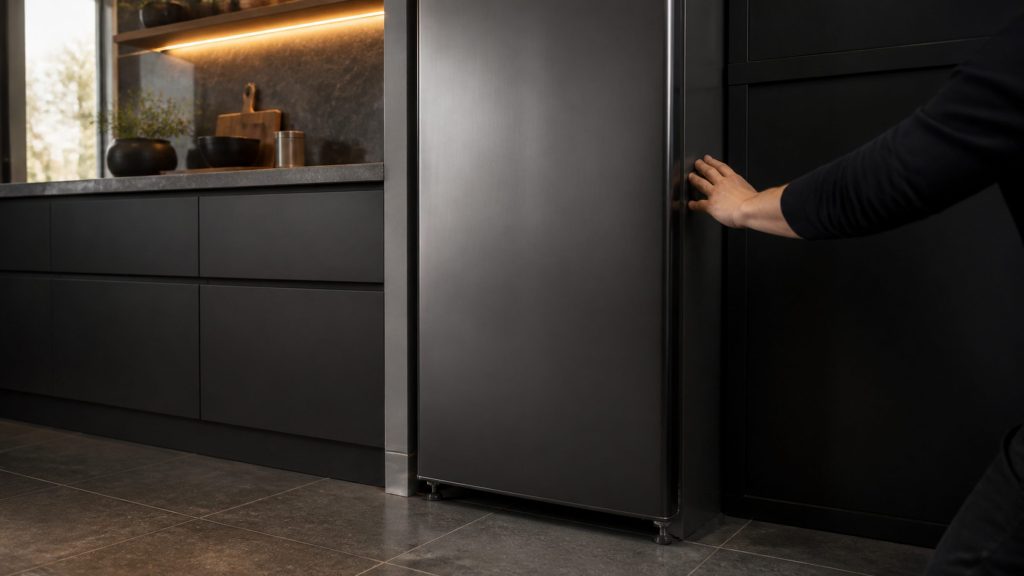
    Fifty-two refrigerators in the current US line, and most of them are built into the kitchen rather than standing in it: twenty-six bottom-freezer cabinets, ten fully integrated behind your own cabinet fronts, ten Side-by-Side pairs and five French-door. Tell us which one you have and what it is doing, and whether it is paneled — that decides how the visit is planned.

    Refrigerator repair
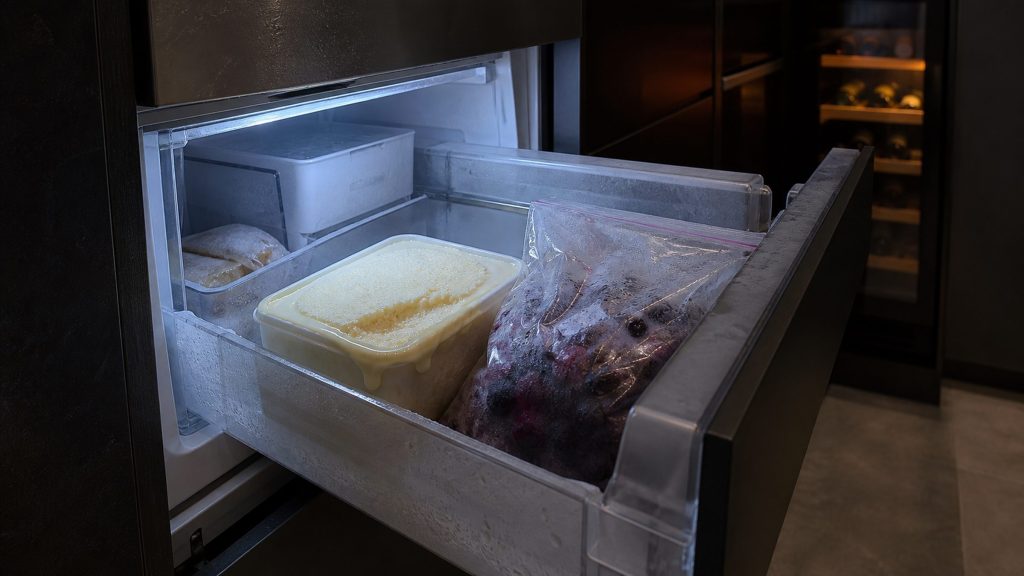
  • A tall fully integrated freezer column standing open in a near-black kitchen run, seen straight on: four clear drawers pulled to different depths on their runners, wrapped frozen packets standing on edge inside them, cold blue-white light and a haze of vapour spilling over the lower drawer, dark stone worktop and amber under-cabinet light to one side.
    Fully integrated columns

    Freezers

    Five freezers in the current US line, every one of them a fully integrated column built into the joinery. They are frequently half of a Side-by-Side pair, which means a freezer that has stopped and a refrigerator that is fine can be two separate machines behind two matching doors.

    Freezer repair
  • A continuous run of near-black kitchen joinery with two tall fully integrated refrigeration columns side by side behind matching cabinet fronts, one door standing slightly open with cold interior light spilling out, dark stone worktop and warm amber light above.
    Ten cabinets · three refrigerators, four freezers, three wine

    Monolith refrigerators

    Monolith is the line Liebherr names for its fully integrated columns, and ten cabinets in the current US catalog carry it: MRB 2400, MRB 3010 and MRB 3600 on the refrigerator side, MF 1851, MF 2461, MF 3051 and MF 3661 on the freezer side, and MW 1810, MW 2400 and MW 2401 for wine. The refrigeration inside is the refrigeration in the rest of the range. What is different is that the cabinet is part of your joinery, and that is what changes about the visit.

    Monolith repair

If there is no code and no light

That is normal here, and it is not a dead end.

Most of this equipment has nothing to show you. What it has instead is behavior — a burner that lights and dies, an oven that browns on one side, a hood that sounds right and clears nothing — and that is a diagnosis, not a shrug. Tell us what it does and when it started.

About the codes

The questions this archive is asked

What does Liebherr error code F2 mean?

Nobody outside the factory can tell you, and this is the honest answer rather than an evasion. The maker prints F1 to F5 and publishes no meaning for any of them: its own manual asks only that you have the number available when you contact service, and its troubleshooting section decodes none of them. Sites that show you a confident table for these numbers cite nothing — and two of the top results for that search are sites we recognize, because they belong to a previous fleet of ours. We are not adding a twelfth version of a guess.

So is the number useless?

No — it is a reference rather than a diagnosis, and it still does real work. It tells us the appliance registered something rather than that you imagined it, it goes to the service department alongside the three numbers off the plate, and it rules out the whole class of complaints where nothing was ever displayed. What it does not do is name a part over the phone.

My freezer is beeping. Is that one of these?

Probably, and probably not a breakage. This maker documents seven behaviors precisely, and every one of them has a page here: a door alarm that sounds after about 180 seconds, a temperature alarm that flashes the display and the alarm LED together, a freezer display showing two dashes until it is below freezing, a power-failure indicator, a display that flashes after a setting change, and an ice-maker lamp asking about its water tank. Most of the calls we take about this make start with one of those.

Should I clear the number before calling?

Write it down first, and photograph the display if you can. On an intermittent problem it is often the only evidence there is, and clearing it erases the one thing that would have told a technician the appliance agreed with you.

What about E081, PH001.1 or BT041? I found those in a search.

Those are not kitchen appliances. Liebherr also builds mining equipment, mobile and maritime cranes and industrial refrigeration, and its search results are shared between all of them. Nothing in that family appears in the domestic manual, so nothing in that family appears here.

In more detail

How to read a Liebherr display in Miami

Start with what the appliance is doing rather than with the number, because on this make the doing is documented and the number is not. Liebherr’s Use and Care Manual describes seven behaviors in detail — an audible alarm silenced by touching its icon, a door alarm after about 180 seconds, a temperature alarm that flashes the display and the alarm LED together until the cause is put right, a freezer display that shows two dashes because it only reports below-freezing temperatures, a power-failure indicator that will tell you the highest temperature reached during an outage, a display that flashes when you change a setting or load warm food, and an ice-maker lamp that flashes when its water tank is empty or unseated. Every one of those has a page in this archive, quoted from the manual.

Against that, the numbers. F1 through F5 appear in the display and the manual says one thing about them: the appliance has registered a problem, and you should have the number available when you contact the customer service department. The Customer Service section repeats it and adds what else to bring — the Type Designation, the Service Number and the Appliance or Serial Number, all three printed on the plate inside the cabinet on the left-hand side. That is the whole of the published guidance, and this archive publishes exactly it.

It would be easy to write more. Third-party pages assign each number to a sensor with complete confidence and no source, and we could copy them in ten minutes. We are not going to, for a reason that is practical rather than high-minded: a technician who arrives carrying the part that F2 supposedly means, on the strength of a table nobody can trace, has made your visit longer rather than shorter. The number narrows the visit. The measurement ends it.

And the manual’s own troubleshooting table — six rows about a dead appliance, an interior light that is out, loud running noise, a motor running too long, a cabinet that is not cold enough, and ice on the rear wall that it calls completely normal — is worth more than any code list, because five of those six start with something you can check yourself for nothing.

Tell us what it is showing, or what it is doing.

Either one is a starting point. You will have the scope and the price in writing before anything is opened.

This article is based on:

  • Official manufacturer documentation
  • Internal repair procedures
  • Technician repair history
  • Company quality standards
Call (305) 928-2637