
Common Problems
Why Your Liebherr Is Making That Noise — and the Two Free Answers
Start with the two questions the maker asks, because both are free and between them they resolve a real share of these calls: is the appliance standing firmly on the floor, and is the compressor making nearby furniture, objects or bottles vibrate. Liebherr's own suggested remedies for a loud running noise are to move the appliance slightly, align it by adjusting the adjustable feet, or adjust bottles and containers — none of which involves a part. Beyond that, when the noise happens tells you what it is. A noise that runs with the compressor cycle and stops when it stops is mechanical and usually mounting or level. A noise that changes when you open the door is the evaporator fan, which on many cabinets runs differently while the door is open. A grinding or ticking that arrived alongside a cooling complaint is often a fan blade catching ice, and that one is worth acting on quickly because it is really a defrost problem announcing itself early. A steady hum that has been there for years is the appliance.
The full guide
The maker asks two questions, and both are free
Why is my liebherr fridge making noise is answered by the manufacturer itself, and its answers cost nothing.
From the Liebherr troubleshooting table, the row for loud running noise:
> Is the appliance standing firmly on the floor, or does the compressor cause nearby items of furniture or objects to vibrate? If necessary, move the appliance slightly, align by adjusting the adjustable feet, or adjust bottles and containers.
Three suggested remedies and not one of them is a part.
Try them properly before anything else:
Push gently on the cabinet while it is running. If the noise changes, it is contact or level rather than machinery.
Look at what is touching it. A cabinet side, a run of joinery, a countertop appliance sitting against it.
Separate the bottles. Especially in a wine cooler, where a dozen bottles resting on each other will ring at a specific compressor frequency and sound exactly like a bearing.
When it happens tells you what it is
With the compressor cycle, stopping when it stops. Mechanical, and usually mounting or level. This is the one the free checks fix.
Changing when you open the door. The evaporator fan — on many cabinets it runs differently, or stops, while the door is open. A noise that disappears the moment you open the door has told you where it lives.
Grinding or ticking, alongside a cooling complaint. A fan blade catching ice. Worth acting on quickly, and not because of the noise: it means the defrost side has stopped clearing the evaporator, and the temperature problem is arriving next.
A steady hum, always there. That is a refrigerator. Cold equipment is not silent, and a cabinet that has hummed for six years is not developing a problem because you noticed it this week.
The order that saves money
- Level and contact. Free, published by the maker, and the answer more often than not.
- The fan. An ordinary repair, and the usual mechanical answer.
- The compressor mount. Least common, most often assumed first.
The one noise that is not a noise
If it is beeping rather than humming, grinding or rattling, that is a different page entirely — this make documents seven separate alarms and indicators, and most of them mean the appliance is working correctly.
Built in changes what you hear, and where from
A column fitted into joinery is surrounded by panels that both muffle and carry sound. That has two consequences worth knowing before deciding a noise is serious. A cabinet can develop a real mechanical noise and sound quieter than a freestanding appliance would; and a cabinet that is perfectly healthy can transmit an ordinary compressor hum into the run of cabinets and into the worktop, where it is far more noticeable than it would be in open air.
The second is much more common than the first, and it is usually contact rather than mechanism: something touching the cabinet that should not be, a plinth panel resting against the appliance, a leveling foot that has worked loose so the weight has shifted onto a corner. All three are worth checking before anybody opens anything, and all three are free.
The one that is worth a call sooner rather than later is a noise that has changed — not a noise that has always been there. A new note, or an old note at a new time in the cycle, is information; a hum you have lived with for three years usually is not.
If it turns out to be a repair
What this leads to, and what it costs
Every job on this site is priced the same way: an on-site diagnostic first, the figure agreed in writing before anybody starts.
-

The maker's own first questions cost nothing Loud running noise
One of the six rows in the maker's own troubleshooting table, and its published answers start with things you can check yourself in two minutes.
- Vibration that comes and goes
- Rattling that stops if you touch the cabinet
- A hum that got louder over months
-
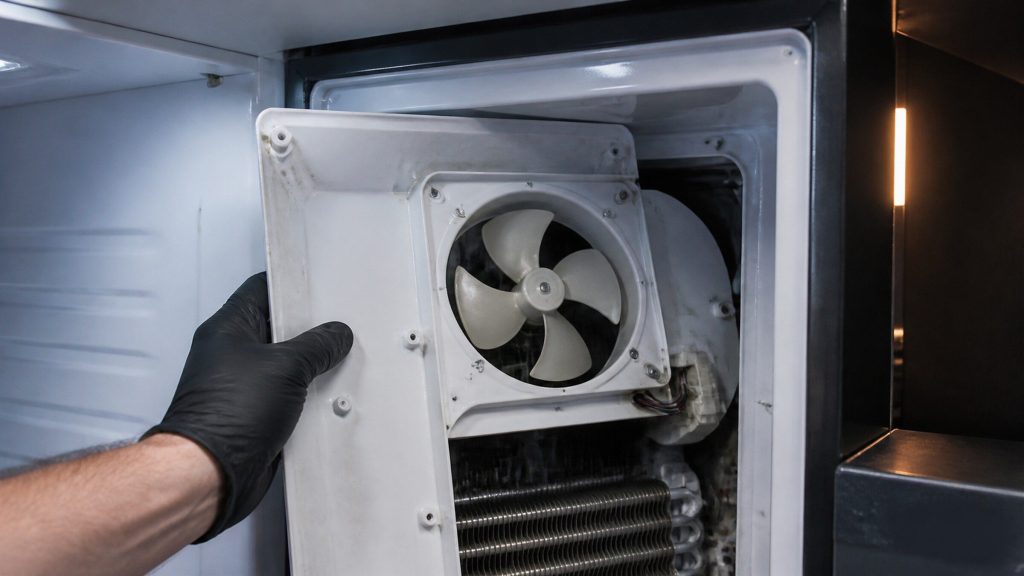
from $175 Evaporator fan and running-noise repair
Loud running noise is one of the manual’s own six troubleshooting rows. It is worth taking seriously and it is worth ruling out the free causes first, because two of the three usual answers cost nothing at all.
- Leveling and contact checked before any part
- Fan, compressor mount and airflow told apart
- A noise that changes with the door is a different answer

Questions people ask about this
Why is my fridge suddenly louder?
Most often something has changed around it rather than inside it — the cabinet has shifted slightly, a bottle is now touching another bottle, or a piece of furniture has moved against it. The maker's own remedies for this row are exactly those three things.
It only makes the noise at night.
Usually because the house is quiet, sometimes because the kitchen is coolest then and the cycle is different. Note whether it coincides with the compressor running, because that is the distinction that matters.
Is a noisy refrigerator dangerous?
Rarely urgent, occasionally an early warning. A fan grinding against ice tells you about a defrost problem before the temperature does, which is one of the few cases where a noise is genuinely worth acting on quickly.
Can I fix it myself?
The two free ones, yes — level the cabinet with its adjustable feet and separate anything that is touching it. A fan or a compressor mount is a visit, and neither is expensive next to what a noisy fan can turn into if it is icing.
Common Problems
More guides like this one
-

Ice on the Back Wall of Your Fridge Is Normal — Here Is When It Is Not
The maker calls it completely normal in its own manual. It is also the most common reason somebody pays to have a working refrigerator looked at.
Read more -

Ice Maker Making No Ice — the Two Free Checks the Maker Publishes
Liebherr's own ice-maker troubleshooting is three rows long and two of them are about the water tank. Start there rather than with a parts list.
Read more -

Why Your Refrigerator Is Freezing Food — and the Free Fix Most People Miss
Ice in the milk and lettuce like glass. Too cold is as wrong as too warm, and it usually has a simpler and cheaper cause.
Read more
Tell us the model number and what it is doing.
This article is based on:
- Official manufacturer documentation
- Internal repair procedures
- Technician repair history
- Company quality standards